Completed PhD and Master thesis projects
- Investigation of sulfur corrosion on electronic components
M.Sc Olga Markaki
- Microstructure and corrosion investigation of Al-Cu bus bars for automotive electrification
M.Sc Reuben Jacob
- Development of corrosion test methods for replicating field failures of hearing aids
M.Sc Azra Cigura
- Parametric study of interior climate in electronic enclosures and corrosion reliability
PhD, Helene Conseil
- Water film formation on PCBA surface: Investigation of aspects contributing to premature corrosion failures and safety measures for electronics reliability improvement
PhD, Kamila Piotrowska
- Numerical Modelling of Local Climate inside Electronics Enclosures
PhD, Parizad Shojaee, (MPP, DTU-MEK)
- Humidity control inside electronic enclosures: Developing design principles based on empirical understanding
PhD, Salil Joshy
- Climatic reliability of electronics: Early prediction and control of contamination and humidity effects
PhD, Vadimas Verdingovas
- Developing semi-empirical models for predicting climate inside electronic device enclosures
PhD, Zygimantas Staliulionis (MPP, DTU-MEK)
- Investigation of Electronic Corrosion Mechanisms
PhD, Daniel Minzari
- Developing strategy for corrosion protection of electronic devices
PhD, Umadevi Rathinavelu
- Corrosion Investigation of Materials For Electrical Contacts
M.Sc, Abhijeet Yadav
- Optimization and Calibration of EIS Based Portable Corrosion Monitor
M.Sc, Anders Hansen
- Corrosion Reliability of Lead-Free Solder Alloy Systems Used in Electronics
M.Sc, Feng Li (BME, Hungary)
- Analysis of humidity on printed circuit boards by impedance spectroscopy: Experiments and modelling
M.Sc, Behshid Azimi Manavi (Bosch)
- Contact resistance testing of materials for electrical contacts in hearing aids
M.Sc, Lise Hansen
- Water transport through silicone gel used in electronics and humidity build up at interfaces
M.Sc, Morten Klitkou
- Sensors for electronic corrosion
M.Sc, Stine Jensen
- Corrosion susceptibility of electronic components in offshore wind turbine nacelle
M.Sc, Bjørn Mikkelsen
- Electrochemical Characterization of Bulk MaxPhase
M.Sc, Eigle Hansen
- Galvanic Corrosion of Material Combinations on PCBAs
M.Sc, Anders Bruhn (NXP, TU Delft)
- Effect of Contamination on Electrochemical Migration
M.Sc, Marianne Johnson
- Improving the performance of conformal coatings on printed circuit board assemblies
M.Sc, Thomas Jensen
- Role of supply chain logistics and manufacturing process on the reliability of electronic devices
M.Sc, Riccardo Rizzo
- Investigation on the effect of ionic contamination on the corrosion reliability of printed circuit board assemblies
M.Sc, Vadimas Verdingovas
- Developing high performance and climatically reliable Hearing Aids
PhD, Abhijeet Yadav (Widex)
- Li-ion batteries for hearing aid applications: Humidity and temperature effects on performance
M.Sc, Vishu Dev
- Detailed investigation of humidity robustness of Zinc-Air batteries
M.Sc, Jyothsna Rao
- Humidity interaction with reflow residue and effect on corrosion reliability of SMT devices
M.Sc, Anish Rao
- Parametric study of regional climates on electronics: Understanding local climate effects on corrosion failure mechanisms
M.Sc, Quimin Guo
Solder flux chemistry and climatic reliability of electronics: optimization of flux chemistry for robust performance
PhD student:
Feng Li
This PhD project is a part of the CreCon Industrial consortium on “Climatically reliable electronics”. Overall aim of the PhD project is to build deep scientific understanding on various parts of solder flux chemistry and combinations of flux components on humidity related reliability issues of electronics with the goal of using the knowledge for making robust flux systems satisfying both climatic reliability and soldering requirements. Overall objective is to develop feasible methods rooted in scientific concepts for making optimized flux chemistry formulations better than the one existing today. Work involves investigation new humidity benign flux activators and finding the effect on humidity robustness when used for electronics, model flux systems and humidity behaviour, understanding soldering related factors, effect on conformal coating etc. Another aspect of the project is understanding the reflow flux residue and humidity interaction. Humidity influence reflow residue by changing the residue morphology. Change in residue morphology leads to release of active components that can cause humidity robustness issues for example related to BGA component. Reflow flux residue and its humidity interaction has been comprehensively investigated in this project including the effect of paste chemistry, component standoff height, thermal effects, humidity exposure and time etc.Project is in collaboration with CreCon Consortium Industrial partners: Danfoss, Vestas Wind Systems, Grundfos, Widex, Eltek, Volvo, Inventec, Wevo. Key industrial partner for the project is Inventec, France.
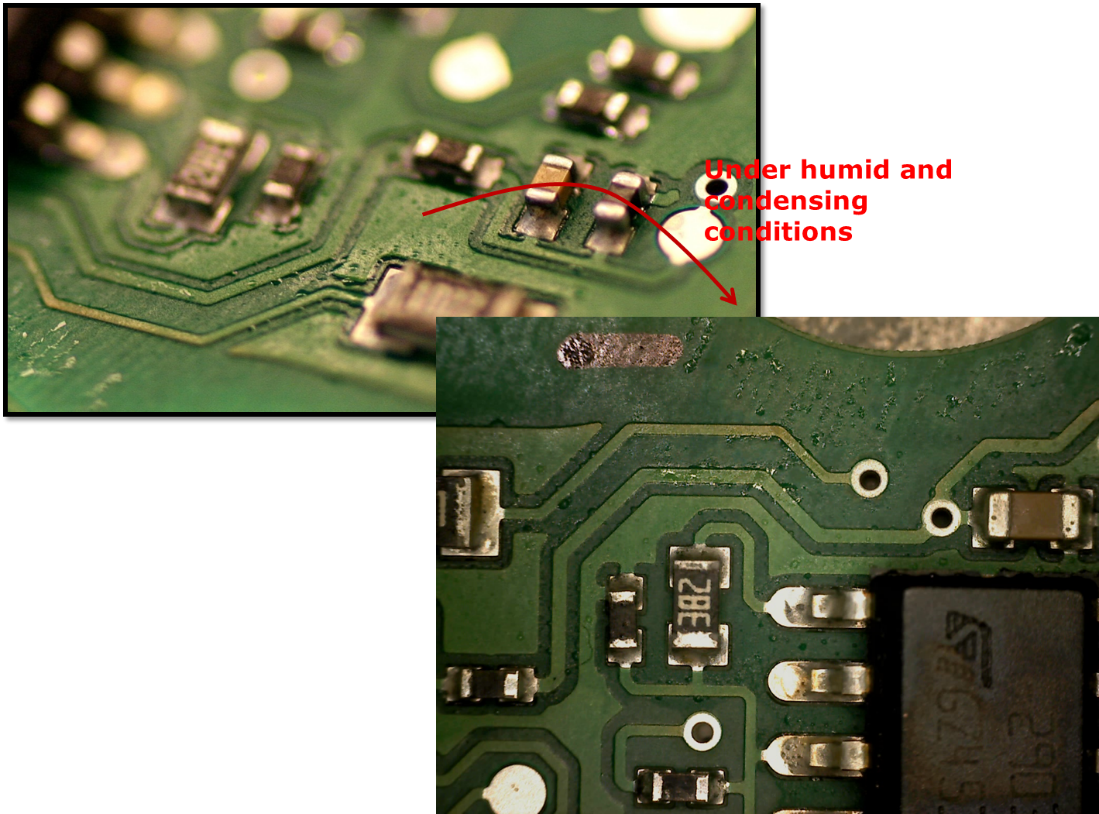
Contamination assisted water film formation on a PCBA under humid condition, which can leads to leak current failures, ECM, or other failure modes
Source of Funding:
CELCORR/CreCon Industrial consortium
Industrial collaborators:
Danfoss, Grundfos, Vestas, Eltek, Widex, Inventec, Wevo, VolvoImplementation of electrochemical impedance spectroscopy (EIS) for validation of humidity robustness of PCBA design elements
PhD Student:
Simone Lauser
The target of this PhD project is to understand the fundamental aspects of thin water film formation on PCBA by investigating the effect of various material, chemical, and design parameters, while the progressive water film buildup is electrochemically characterized for its electrical properties. The electrical properties of interest are the dielectric and resistive behavior as the water film build-up. The electrical properties of the water film result from the electrochemical process at the connecting bias points on the PCBA, while the water film thickness and ionic strength determine the transition from capacitive to resistive mode causing electrical failures.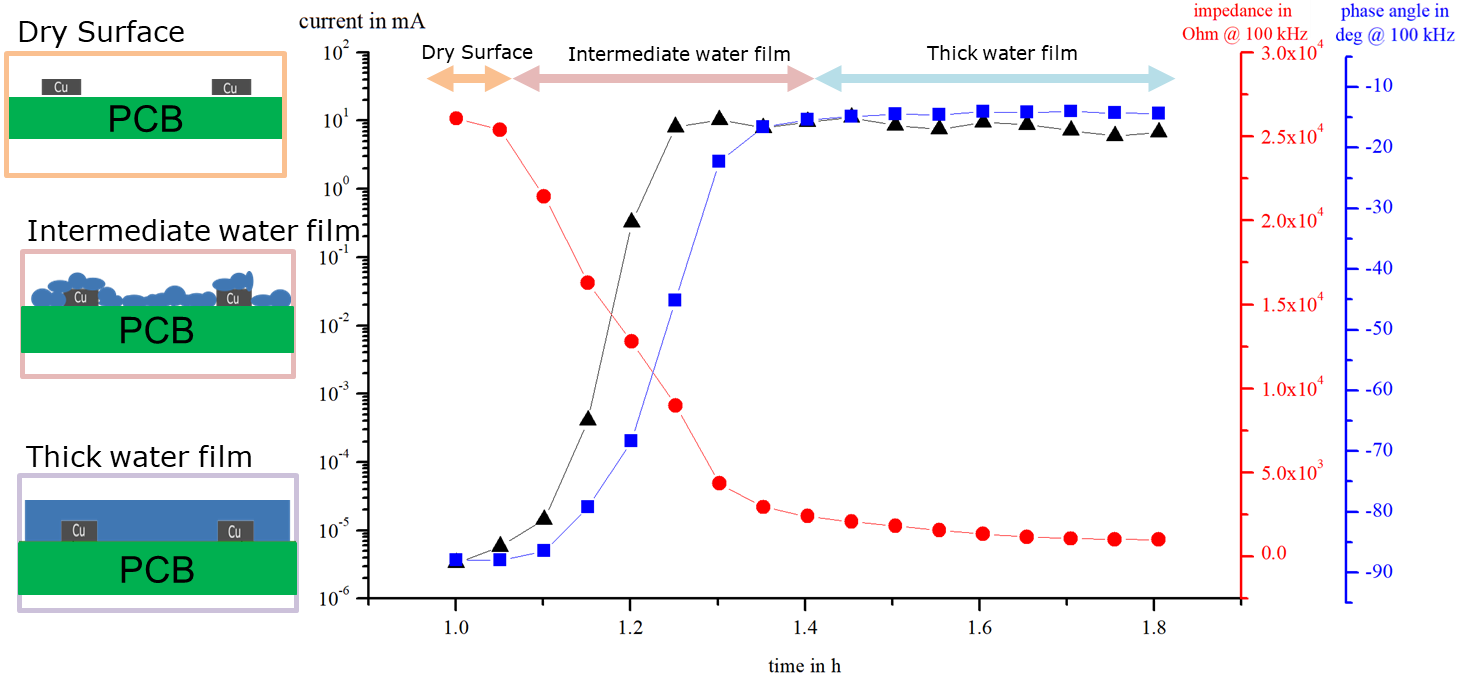
Funding:
This PhD project is funded by Robert Bosch GmbH.
Humidity Robustness of Electronic Devices: PCBA Failure Risk Prediction based on Probabilistic Approach
PhD student:
Sajjad Bahrebar
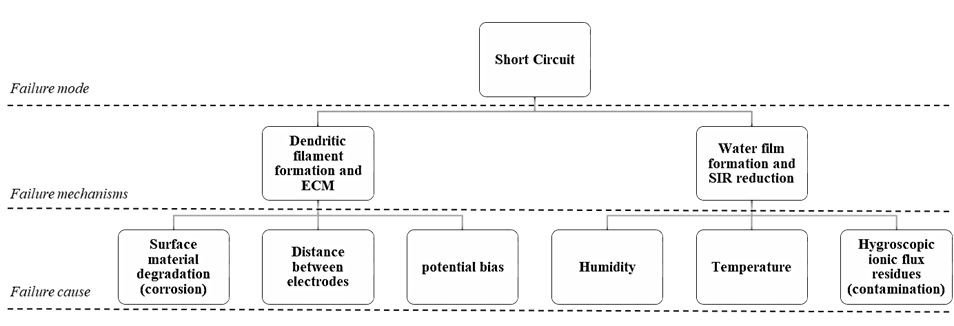
This Ph.D. project is part of ELMAC (Electronics Manufactured for Climate) and CreCon Industrial consortium on climatically reliable electronics. focus on understanding the interplay between electrochemical mechanisms and failure of electronic devices due to change in electrical functionality under humid conditions. The effect is due to water film formation, which is a combination of many factors including nature of the PCBA surface, cleanliness level, humidity, and temperature. The project will focus on electrochthemical impedance and DC electrochemical methods in understanding the water film formation and accurately measuring the electrical/electrochemical properties. The final goal of the project is to use probabilistic approach based on parametric investigations to define failure models and risk factor prediction, which can be implemented at PCBA leve for risk prediction when parameters are known.This PhD project is part of the ELMAC consortium project (Electronics manufactured for climate).
Funding:
ELMAC Project and CreCon Industrial Consortium
ELMAC project partners:
